|
Dr. W. Bruce Cornet
PhD in geology/palynology, Masters in paleobotany, BS in biology
(click below for resume)
Geology
Permian
Reefs and Carbonate Complexes, West Texas
Franklin Mountains, El Paso, TX (short
page)
EPCC
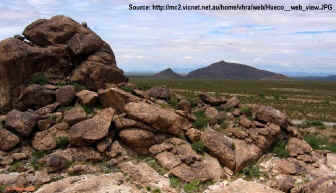
Geology Field Trip (Hueco Tanks State Park)
Big
Bend National Park & Big Bend Ranch State Park TEXAS
Permian
Back-Lagoon Island and Reef Exposed in Highway Outcrop
Dr. Bruce Cornet's Ph.D.
Thesis
The Palynostratigraphy
and Age of the Newark Supergroup, 1977: 505 p. Thesis advisor: Dr.
Alfred Traverse. “Bruce's doctoral dissertation is still cited
at PSU as one of the very best in the history of the Department of
Geosciences.” http://www.palynology.org/history/traverse.html#cv
List of Scientific Publications
Cornet, B. and Abushagur, S., 2005. Take
Virtual Tours to the Franklin Mountains of El Paso, Permian Basin and Big
Bend of West Texas, and Cretaceous of New Jersey. http://www.epcc.edu/sites/faculty/brucec/
Vasanthy, G., Cornet, B., and Pocock,
S.A.J., 2004. Evolution of proangiosperms during
Late Triassic: pre-Cretaceous pollen trends towards mono- and
dicotyledonous taxa diversification. Geophytology
33(1&2):
99-113. http://www.sunstar-solutions.com/sunstar/Vasanthy04/Vasanthy_Cornet_Pocock04.htm
Cornet, B., 2003. Upper Cretaceous
facies, fossil plants, amber, insects and dinosaur bones, Sayreville, New
Jersey. http://www.sunstar-solutions.com/sunstar/Sayreville/Kfacies.htm
Cornet, B., 2002. When did angiosperms
first evolve? http://www.sunstar-solutions.com/sunstar/Why02/why.htm
Cornet. B., 1999. Fossil evidence for
rapid orderly genetic evolution: The first detailed fossil record of
microevolution with missing links. http://www.sunstar-solutions.com/sunstar/Crinopolles/crinopolles.htm
Cornet, B., 1996. A new gnetophyte from the late Carnian
(Late Triassic) of Texas and its bearing on the origin of the angiosperm
carpel and stamen. In Taylor and Hickey (eds.), Angiosperm origin,
evolution and phylogeny, Chapman & Hall, NY, 32-67. http://bcornet.tripod.com/Cornet96/Archaestrobilus.htm
Cornet, B. and McDonald, N.G. (Abst. 1995
and MS). A new cheirolepidaceous conifer bearing
flowers from the Early Jurassic of Connecticut, USA. http://www.sunstar-solutions.com/sunstar/Conanthus/conanthus.htm
Fowell, S.J., Cornet, B., and Olsen,
P.E., 1994. Geologically rapid Late Triassic extinctions: Palynological
evidence from the Newark Supergroup. Geological Society of America Special
Paper 288: 197-206. http://bcornet.tripod.com/MassExt/Fowell94.htm
Cornet, B., 1993. Applications and
limitations of palynology in age, climatic, and paleoenvironmental analyses
of Triassic sequences in North America. In Lucas and Morales (eds.), The
Nonmarine Triassic. New Mexico Museum of Natural History & Science
Bulletin, 3: 75-93. http://bcornet.tripod.com/Cornet94/Cornet94.htm
Cornet, B., 1993. Dicot-like leaf and
flowers from the Late Triassic tropical Newark Supergroup rift zone, U.S.A.
Modern Geology, 19: 81-99. http://bcornet.tripod.com/Cornet93/Cornet93.htm
Olsen, P.E., McDonald, N.G., Huber, P.,
and Cornet, B., 1992. Stratigraphy and paleoecology of the Deerfield rift
basin (Triassic-Jurassic, Newark Supergroup), Massachusetts. Guidebook for
Field Trips in the Connecticut Valley Region of Massachusetts and Adjacent
States, vol. 2, 84th Annual Meeting, New England Intercollegiate
Geological Conference, The Five Colleges, Amherst, Massachusetts, October
9-10-11: 488-535 http://www.sunstar-solutions.com/sunstar/Olsenetal92/NEIGC84.htm
Cornet B. and Habib, D., 1992.
Angiosperm-like pollen from the Late Jurassic (Oxfordian) of France. Review
Paleobotany Palynology, 72: 269-294. http://bcornet.tripod.com/Cornet92/CH92a.htm
Cornet, B., 1989. The reproductive
morphology and biology of Sanmiguelia lewisii, and its bearing on angiosperm evolution
in the Late Triassic. Evolutionary Trends in Plants, 3: 25-51 (cover
picture). http://bcornet.tripod.com/evtrend/Sanmig2.htm
Cornet, B., 1989. Angiosperm-like pollen
from the Late Triassic Richmond rift basin of Virginia. Palaeontographica,
213B: 37-87. http://bcornet.tripod.com/RBpollen/primref.htm
Cornet, B., 1986. The reproductive
structures and leaf veneation of a Late Triassic
angiosperm, Sanmiguelia lewisii. Evolutionary Theory, 7: 231-309. http://bcornet.tripod.com/evoltheo/Slewisii.htm
Cornet, B. and Traverse, A., 1975. Palynological
contributions to the chronology and stratigraphy of the Hartford basin in
Connecticut and Massachusetts. Geoscience and Man, 11: 1-33. http://bcornet.tripod.com/hartford/Hartford.htm
Cornet, B., Traverse, A., and McDonald,
N.G., 1973. Fossil spores, pollen, and fishes from Connecticut indicate
Early Jurassic age for part of the Newark Group. Science, 182: 1243-1247.
http://www.sunstar-solutions.com/sunstar/science73/1stpaper.htm
FOR NEW TITLES/PUBLICATIONS THAT MAY/MAY NOT BE ON THIS LIST
CLICK HERE
Field Work Experience
1969 Summer, Yale University sponsored field trip to Oligocene
mammal beds in northwestern Nebraska. Collected numerous partial and
complete mammal skeletons and skull bones, including the first complete
skeleton of Daphaenocyon dodgei, which was prepared and exhibited at the
Yale Peabody Museum. http://www.sunstar-solutions.com/AOP/SOW/vpaleo.htm
1969-1970, quarried and excavated an Early Jurassic
lacustrine fish bed in the Hartford basin, Connecticut, with Nicholas
McDonald. Prepared numerous fish specimens, some for exhibit at the Rocky
Hill Dinosaur Park in Connecticut. Most of the fish specimens are now at
the American Museum of Natural History, and many have been used in various
scientific publications by various authors.
http://www.sunstar-solutions.com/sunstar/BluffHead/blufhead.htm
1981-1982; 1985-1986, wildcat oil drilling in the Triassic
Richmond basin of Virginia. Described and analyzed thousands of feet of
strata using well cuttings and electric logs.
http://sunstar-solutions.com/AOP/SOW/geminoil.htm
1988-1993, extensive field work in the Newark basin of New
Jersey and in the Richmond basin of Virginia, mapping strata and collecting
fossils. Wellsite geologist for the Newark Basin Coring Project: Described,
photographed, and analyzed over 21,000 feet of strata from seven coreholes (1990-1993). http://www.ldeo.columbia.edu/~polsen/nbcp/nbcp.html
|